Monday, 31 October 2011

600,000 hacks a day, welcome to Facebook

Every 24 hours 600,000 Facebook accounts are subject to attempted hacking or violation, Facebook has revealed.

The Social Network™ disclosed details of hacking activity as it unveiled new measures to protect user’s privacy. “We are adapting and responding to new threats everyday and will continue to roll out new ways to protect your account,” Facebook said.

In a blog post, Facebook revealed new tools to help users access their accounts if they are locked out and help prove your identity through your friends. “It's sort of similar to giving a house key to your friends when you go on vacation - pick the friends you most trust in case you need their help,” it explains.

‘Trusted friends’ allows users to nominate a few friends as a default measure that will be given access codes to your account if you cannot access it.

It is also testing a feature that allows users to use app passwords for logging into third party applications.

Initial feedback from users has been mixed with many pointing out that “friends” are also subject to hacking and security maybe further compromised by exposing access information to other parties.

Meanwhile according to researchers at Barracuda Labs, one in 100 tweets are malicious while one in 60 Facebook posts are malicious

Thursday, 27 October 2011

Hackers could have TAKEN OVER Amazon Web Services

Security researchers have unearthed a flaw in Amazon Web Services that created a possible mechanism for hackers to take over control of cloud-based systems and run administrative tasks.

The flaw, which affected Amazon's EC2 cloud and has already been plugged, could have been abused to start and stop virtual machines or create new images in an EC2 virtual environment, for example. The root cause of the security weakness stemmed from poor cryptographic practices

Tuesday, 25 October 2011

BT cable hooks up punters to wrong numbers

Several BT phone customers in Surrey ended up fielding calls from strangers after engineers screwed up while rewiring their cables.

Pauline and Thomas Rodgers started to receive phone calls for a bloke called Charlie after BT relaid cables in their local area. The repair work in Wanborough Hill, Surrey, took place after thieves stole hundreds of metres of BT's copper cables, taking down phone and internet connections in the area.

Some customers are concerned that with the mix-up they'll be liable for other people's phone bills. BT have told them to get in contact to resolve the issues.
A BT spokesman explained: “During complex repairs such as this there can be instances where individual lines can be connected incorrectly.
“We are working on a handful of residual faults caused by this cable theft.”
He said anyone experiencing problems should contact BT. ®

Monday, 24 October 2011

Massive study concludes: Global warming is real

A massively thorough study – funded in part by a pair of US oil billionaires who are opponents of climate-disruption remediation – has come to the conclusion that the earth is, indeed, warming.

In fact, it's warming just as much as more-limited studies conducted by the US National Oceanic and Atmospheric Administration, NASA, and the UK's Met Office Hadley Centre for Climate Change said it was: about 1°C since 1950.

The study – the Berkeley Earth Surface Temperature (BEST) project – was set up by a University of California astrophysicist who was concerned about the "climategate" dustup over email messages hacked from the UK's University of East Anglia (UEA) that led many observers to believe that climate data had been fudged to exaggerate global warming.

The core of UC Berkeley scientist Richard Muller's concern was not, however, that the UEA scientists were getting a raw deal; in his opinion they had brought the worldwide criticism upon themselves.

"I was deeply concerned that the group [at UEA] had concealed discordant data," Muller told BBC News. "Science is best done when the problems with the analysis are candidly shared."
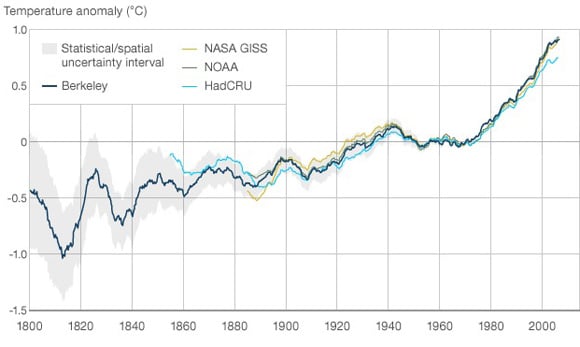
Berkeley Earth Surface Temperature project results The BEST project's results conform closely to those determined by less-rigorous studies (source: BBC)

Muller gathered together a group of 10 prominent scientists – among them recent Nobel Prize winner Saul Perlmutter – to creat BEST. Funding was provided by such disparate sources as Bill Gates ($100,000) and the Koch foundation ($150,000), the latter accurately described by the foundation managing the funding as an organization "whose animosity towards action on climate change made the Berkeley project look yet more suspicious to some climate-change activists."

The BEST team, however, had a stated goal of neither proving nor disproving global temperature increases. As expressed by project cofounder Elizabeth Muller, Richard's daughter, the goal was to conduct an analysis so data-rich and objective that it would "cool the debate over global warming by addressing many of the valid claims of the skeptics in a clear and rigorous way."

The "valid claims" didn't survive.

For one, skeptics have charged that previous studies were done with selective data sets, but BEST lead scientist Robert Rhode points out that his team's analysis "is the first study to address the issue of data selection bias, by using nearly all of the available data, which includes about five times as many station locations as were reviewed by prior groups."

The data set was large, indeed: temperature data was gathered from 39,028 sites, collected by 10 different sources, resulting in 1.6 billion data points.

Another objection that has been raised is that temperature observations over the decades have been influenced by sensors being encroached upon by human development – the "urban heat island" (UHI) effect. The BEST analysis, however, found this effect to be negligible at best

Updated site.

Check out our updated site IT Support Bristol :)

Wednesday, 19 October 2011

Database security firm Imperva has been keeping close tabs on an unnamed hacking

Database security firm Imperva has been keeping close tabs on an unnamed hacking message board with nearly 220,000 registered members since 2007. It discovered that the forum is used by hackers of varying abilities for "training, communications, collaboration, recruitment, commerce and even social interaction". Chat rooms are filled with discussions on everything from attack planning to requests for help with specific campaigns. Newbies can use the forums to find "how-to-hack" tutorials.

Meanwhile the forum's marketplace acts as an underground bazaar for the sale of either stolen data or attack tools. Other studies by the likes of Symantec have focused on the price of stolen credit card numbers or licensing prices for ZeuS banking Trojan toolkits, for example. Imperva by contrast has paid closer attention to the content of conversations, picking up clues about evolving hacking tactics and approaches in the process.

Monday, 17 October 2011

According to research commissioned by paper-shredding kit supplier Fellowes, 7 per cent of the UK population (4 million people) have been victims of identity fraud at one time or another. According to the UK’s fraud prevention service CIFAS, 80,000 have been targeted this year. The average cost of an identity theft is £1,190, but some individuals have been stung to the tune of £9,000.
Virgin Media customers in London and the South East have been rocked by internet outages that cut them off from big sites including Wikipedia, Yahoo! and the Guardian yesterday and this morning. Reg readers bombarded our inbox to report pockets of dicky service, which seemed to start on Sunday morning and is still ongoing for some people.

Saturday, 15 October 2011

The new Siri for the Iphone 4s is outstanding. Apple setting the bar high again.

Friday, 14 October 2011

One in five BlackBerry phone users is considering switching to another supplier because of the service problems which hit millions of people this week, according to a study today.
Created new account on blogger today and will make sure we update our news more often. :)